Showing posts with label Finance. Show all posts

Saturday, June 19, 2021

Stonks are What You Can Get Away With: NFTs and Financial Nihilism


Eric Jang, "Ten Apes", Jun 19 2021. NFT "drop" coming soon.


Andy Warhol once said, “Art is what you can get away with.” I interpret the quote as a nihilistic take on “beauty is in the eye of the beholder” — a urinal you found in the junkyard can be considered art, so long as you convince someone to buy it, or showcase it in a museum. All that matters is what other people see in it and what buyers are willing to pay.

The 2020’s equivalent of Warhol paintings are Non-Fungible-Tokens (NFTs). In this essay I’ll explain what NFTs are by motivating them with some interesting real-world problems. Then I’ll discuss why the NFT craze for digital art generates so much ideologically contentious debate. Finally, I’ll discuss some parallels between artistic and financial nihilism, and how this might serve as a framework for thinking about wildly speculative markets.


Explaining NFTs using Counterfeit Goods


Suppose you want to buy a Birkin bag or some other luxury brand item. An unauthorized seller — perhaps someone who needs some emergency cash — is willing to sell you a Birkin bag. They offer you a good discount, relative to the price the authorized retailer would charge you. But how can you be sure they aren’t selling you a fake? Counterfeits for these items are very high quality, and the average Birkin customer probably can’t tell the difference between a real and a fake.

One way to avoid counterfeits is to only purchase items from an authorized retailer, e.g. a trusted Hermès store. But this is not practical because it prevents people from selling or giving away their bags. If you leave your bag to someone in your will, then its authenticity is no longer guaranteed.

So we have the market need: how does a seller pass on or sell a luxury item? How does a buyer ensure that they are buying an authentic item?

One possible answer is for Hermès to print out a list of secret serial numbers, perhaps sewn inside the bag, that declare whether a bag is legit or not. Owners receive a serial number when they buy the bag. But this is not a strong deterrent. A counterfeiter could just buy a real bag and then copy its serial number into many fake bags.

What if Hermès maintains a public website of who owns which bag? Any time a bag changes ownership, this ledger needs to be updated. By recording a unique owner for each unique serial number, this solves the problem of counterfeiters simply duplicating serial numbers. The process shifts from verifying properties to verifying transactions and owners.

These approaches would work, but also have a centralized point of failure: If the Hermès website goes down, nobody can trade bags anymore. Hermès is a big company and has the resources to protect their website against DDOS attacks and other cybersecurity threat vectors, but smaller luxury brands might not have a state-of-the-art security department. If they are not careful, their security could be breached by hackers or an unscrupulous sysadmin. Also, if Hermès stops operating as a company in 25 years, who will maintain the ledger of ownership? If it is a third party company, can we trust them not to abuse that power? Even in the unlikely event that the central point of failure never makes a mistake, it’s still mildly annoying to require Hermès to get involved every time a bag changes hands.

What if you could verify transactions and owners, without a centralized party? This is where Non-Fungible Tokens, or NFTs, come in. In 2009, someone published a landmark paper on how to build a decentralized ledger of who owns what. This ledger is called a "blockchain". A blockchain is a record of the consensus state of the world, following some agreed-upon protocol that is known to everyone. The remarkable thing about blockchains is that they are decentralized (no central point of failure), and resilient to malicious actors in the network. Distributed consensus is reached by each individual contributing some resource like money, hash rate, or computer storage. So long as a large fraction of resources in the network are controlled by well-behaved actors, the integrity of the blockchain remains secure. The fraction required typically varies from one-thirds to just over a half.

There are many blockchains out there. The details of how their consensus protocols are implemented are fascinating but beyond the scope of this essay. The important thing to know is that the base technology underlying NFTs and cryptocurrencies is a formal protocol that allows people to come to an agreement on who owns what without having to involve a trusted third party (e.g. Hermès, an escrow agent, your bank, or your government). Theoretically speaking, blockchains allow shared consensus in a trustless society.

NFTs are like a paper deed of ownership, but instead of paper the certificate is digital. And unlike a paper deed an NFT cannot be forged. NFTs contain a unique “serial number” that is publicly viewable, but only one person can be said to “possess” that serial number on the blockchain, much like how home addresses are public but registered to a single owner by the recording office. To see how NFTs solve the Birkin bag counterfeit problem, let’s suppose Hermès publicly declares the following for all to hear:

“Owners of True Birkin bags will be issued a digital certificate of authenticity represented by an NFT”

As a buyer, you can be quite confident that the bag is authentic if the seller also owns the NFT, and you can verify that the NFT was indeed originally created by Hermès by looking up its public transaction history. During a transaction, the seller simply gives the buyer the bag and tells the blockchain to re-assign ownership of the NFT to the buyer’s digital identifier. If the payment is done in cryptocurrency, the escrow can even be performed using a smart contract without a centralized party (the seller publishes contract “If a specific buyer’s wallet address sends me X USDC in 24 hours, send the NFT is sent to them and send the cash to me.”)

NFTs provide the means to implement digital scarcity, but there still needs to be a way to pair it with a real-world item in the “analog” world. A seller could still bypass the security of NFTs by selling you an NFT with a fake Birkin bag. However, for every fake bag you want to sell, you need to purchase a real NFT and the real bag that comes with it. After you sell the NFT with the fake bag, you are left with a real bag with no NFT! Subsequently, the market value of the real bag drops because buyers will be highly suspicious of a seller who says "this is a real bag, I don't have the NFT because I just sold it with a fake bag." While NFTs are not sure proof of a physical Birkin bag's authenticity, they all but ruin the economic incentives of counterfeiting.

What about luxury consumable goods? You could buy NFT-certified Wagyu beef, sell the NFT with some cheaper steak, and then eat the real Wagyu beef - it doesn’t matter what other people think you're eating. However, NFT transactions are public, so a grocery shopper would be quite suspicious of a food NFT that has changed hands outside of the typical supply chain addresses. For NFTs paired with physical goods, each “unusual” transaction significantly adds to counterfeit risk, which diminishes the economic incentives to counterfeiters. This is especially true for consumable, perishable goods.

Authenticity is useful, even outside of Veblen goods. You can imagine using NFTs to implement anonymous digital identity verification (a 30B market by 2024), or ship it with food products like meat where the customer cares a lot about the provenance of the product. In Taiwan, there is a current ongoing scandal where a bunch of US-imported pork has been passed off as “domestic pork” and nobody can trust their butchers anymore.

In the most general case, NFTs can be used to implement provenance tracking of both physical and digital assets - an increasingly important need in our modern age of disinformation. Where did this photo of a politician come from? Who originally produced this audio clip?

The Riddle of Intangible Value


NFTs make a lot of sense for protecting the authenticity of luxury goods or implementing single sign-on or tracking the provenance of meat products, but that’s not what they’re primarily used for today. Rather, most people sell NFTs for digital art. Here are some early examples of art NFTs, called “Cryptopunks”. Each punk is a 24x24 RGB image.


One of these recently sold for 17M USD in an auction. At first glance, this is perplexing. The underlying digital content - some pixels stored in a file - are freely accessible to anyone. Why would anyone pay so much for a certificate of authenticity on something that anyone can enjoy for free? Is the buyer the one that gets punked?

It’s easy to dismiss this behavior as poor taste colliding with the arbitrarily large disposable income of rich people, in particular crypto millionaires that swap crypto assets with other crypto millionaires. While this may be true, I think it’s far more interesting to ask “what worldview would cause a rational person to bet $17M on a certificate for a 24x24x3 set of pixel values”?

Historically, the lion’s share of rewards for digital content has been owned by distribution technology like Spotify or content aggregators like Facebook, and then split with the management company. The creatives themselves are paid pittances, and do not share in the financialization of their labor. The optimist case for NFT art is as follows: NFTs are decentralized, which means any artist with an internet connection can draw up financial contracts for their art on their own terms. If NFTs revolutionize the business model of digital art, and if the future of art is mostly digital, then the first art NFTs to ever be issued might accrue significant cultural relevance, and that’s why they command such high speculative prices.

Valuing art based on cultural relevance might be a bit absurd, but why is the Mona Lisa “The Mona Lisa”? da Vinci arguably made “better” paintings from a technical standpoint. It's because of intangible value. The Mona Lisa is valuable because of its cultural proximity to important events and people in history, and the mimetic desire of other humans. In fact, it was a relatively obscure painting until 1911, when it was stolen from the Louvre and became a source of national shame overnight.

All art, from your child’s first finger painting, to an antique heirloom passed down generations, to a “masterpiece” like the Mona Lisa, are valued this way. They are valuable simply because others deem it valuable.

NFTs are the digital equivalent of buying a banana duck-taped to a wall; you are betting that in the future, that statement of ownership on some blockchain will be historically significant, which you can presumably trade in for cash or clout or both. But buyer beware: things get philosophically tricky when applying the theory of “intangible value” to digital information and artwork where the cost of replication goes to zero.

I can think of two ways to look at how one values NFTs for digital art. One perspective is that in a world full of fake Birkin bags and products sourced from ethically dubious places, the only thing of value is the certificate of authenticity. The cultural and mimetic value of content has transferred entirely to the provenance certificate, and not the pixels themselves (which can be copied for free). If art’s value is derived from the cultural relevance it represents and its proximity to important people, then the most sensible way to make high art would not be to improve one’s painting skills, but to schmooze with a lot of famous people and insert oneself into important events in history, and issue scarce status symbols for the bourgeoisie. Warhol did exactly that. 

The alternate view is that if a perfect copy can be made of some pixels, then it is not really a counterfeit at all, and therefore the NFT secures nothing of actual value. Is it meaningful to ascribe a certificate of authenticity to something that can be perfectly replicated? Is “authenticity” of a stream of 0s and 1s meaningless? There is certainly utility in verifying the source of some information, but anyone can mint an NFT for the same information.

In summary, the Pro-NFT crowd values the intangible “collector’s scarcity and cultural relevance”. The anti-NFT focuses on tangible value - how much real value does this secure? Both are reasonable frameworks to value things, and you can end up with wildly different conclusions.

Artistic and Financial Nihilism: One and The Same?


Convince enough people that a urinal is valuable, and it becomes an investment grade asset. This is no longer merely a matter of art philosophy - when you invest in an index fund, you are essentially reinforcing the market’s current belief of valuations. When people bid up the price of TSLA or GME to stratospheric valuations, the index fund must re-adjust their market-weighted holdings to reflect those prices, creating further money inflows to the asset and thus a self-fulfilling prophecy. As it turns out, the art-of-investing is much like investing-in-art. As I have suggested in the title of this essay and borrowed from Warhol (who probably borrowed it from Marshall McLuhan), stonks are what you can get away with.


We are starting to see this valuation framework being applied to the equities market today, where price movements are dominated by narratives about where the price is going and what other people are willing to pay for it, especially with meme stocks like GME and AMC. Many retail investors don’t really care about whether GME’s price is justified by their corporate earnings - they simply buy at any cost. This financial nihilism - where intrinsic value is unknowable and all that matters is what other people think - is a worldview often encountered in Gen Z retail traders and a surprising number of professional traders I know. Perhaps the midwit meme is really true.

This is definitely a cause for some concern, but at the same time, I think value investors should keep an open mind that what first seems like irrational behavior might have a method to madness. If you have an irrational force acting in the markets, like shareholders who refuse to sell or lend their stock, a discounted cash flow model for AMC or GME starts to not become very predictive of share price. By reflexivity, that will have impacts on future cash flows! In a similar fashion, using present-day frameworks for thinking about business and value do not account for the disruptive force of technology. That’s why I find NFTs so fascinating - they are an intersection of finance, art, technology, and the nihilistic framework of valuation that is so prevalent in our society today. 

What is rational behavior for an investor, anyway? Is it “standard behavior” as measured against the population average? How do you tell apart standard behavior from a collective delusion? Perhaps the luxury bag makers, Ryan Cohens, and Andy Warhol’s of the world understand it best: Convince the world to believe in your values, and you will be the sanest person on the planet. For fifteen minutes, at least.

Acknowledgements

Thanks to Cati Grasso, Sam Hoffman, Phúc Lê, Chung Kang Wang, Jerry Suh, and Ellen Jiang for comments and feedback on drafts of this post.

Wednesday, May 26, 2021

Sovereign Arcade: Currency as High-Margin Infrastructure

This essay is about how the powerful want to become countries, and the implications of cryptocurrencies on the sovereignty of nations. I’m not an economics expert: please leave a comment if I have made any errors.

Money allows goods, services, and everything else under the sun to be assigned a value using the same unit of measurement. Without money, society reverts to bartering, which is highly inefficient. You may need plumbing services but have nothing that the plumber wants, so your toilet remains clogged. By acting as a measure of value everyone agrees on, money facilitates frictionless economic collaboration between people.

Foreign monetary policy is surprisingly simple to understand when viewed through the lens of power and control. Nation states get nervous when other nation states get too powerful, and controlling the currency is a form of power.

To see why this is the case, let’s consider a Gaming Arcade (yes, like Chuck E. Cheese) as a miniature model of a “Nation State”. To participate inside the “arcade economy”, you are to swap your outside money (USD) for arcade tokens.

Arcades are like mini nation-states: they issue their own currency, encourage spending with state-owned enterprises, and have a one-sided currency exchange to prevent money outflows.


The coins are a store of value that facilitate a one-way transaction with the Nation-State: you get to play an arcade game, and in return you get some entertainment value and some tickets, which we call “wages”.

The tickets are another store of value that can facilitate another one-way transaction: converting them into prizes. Prizes can be a stuffed animal or something else of value. Typically, the cost of winning a prize at an arcade is many multiples of what it would cost to just buy the prize at an outside store. The arcade captures that price difference as their profit.

Money’s most important feature requirement is that it is a *stable* measure of value. Too much inflation, and people stop saving money. Too much deflation, and people and companies aren’t incentivized to spend money (for example, employing people). Imagine if tomorrow, an arcade coin could let you play a game for two rounds instead of one, and the day after, you could play for four rounds! Well, no one would want to play arcade games today anymore.

The arcade imposes many kinds of draconian capital controls, and in many ways resembles an extreme form of State Capitalism:
  • All transactions are with state-owned enterprises (the arcade games) and must be conducted using state currencies (coins and tickets). You can’t start a business that takes people’s coins or tickets within the arcade.
  • The state can hand out valuable coins at virtually zero cost without worrying about inflation - every coin they issue is backed by a round of a coin-operated game, of which they have near-infinite supply. They can’t hand out infinite tickets though, because that would either require backing it up with more prizes, or devaluing each ticket so that more tickets are needed to buy the same prize.
  • You can bring outside money into the arcade, but you can’t convert coins, tickets, or prizes into money to take out.

Controlling the currency supply is indeed a very powerful business to be in, and why arcades would prefer to issue their own currency and keep money from leaving their borders.

Governments are just like arcades. They prefer their citizens and trading partners to use a currency they control, because it gives them a lever with which they can influence spending behavior. If country A uses country B’s currency instead, then country B’s currency supply shenanigans can actually influence saving and spending behavior of country A. This can pose a threat to the sovereignty of a nation (a fancy way to say “control over its people”).

After World War II, the US Dollar became the world’s reserve currency, which means that it’s the currency used for the majority of international trade. The USA wants the world to buy oil with US dollars, and we go to great lengths to enforce it with various forms of soft and hard power. The US dollar is backed by oil (petrodollar theory), and this “dollars-are-oil rule” in turn is enforced by US military might.

Governments print money all the time to pay for needed short-term needs like building bridges and COVID relief. However, too much of this can be a dangerous thing. The government gets what it wants in the short term, but more money chasing the same amount of goods will cause businesses to raise prices, causing inflation. Countries like Venezuela and Turkey who print too much of their own currency experience a runaway feedback loop where money supply and prices skyrocket, and then no one trusts the government currency as a stable source of value anymore.

The USA is not like other countries in this regard; controlling the world’s reserve currency gives the USA the ability to print money like no other country can. The US government owing 28 trillion USD of debt is like the Arcade owing you a trillion game coins. Yes, it is a lot of coins - maybe the arcade doesn’t even have a trillion coins to give you. But the arcade knows that you know that it’s in the best interest of everyone to not try and collect all those coins right away, because the arcade would go bankrupt, and then the coins you asked for would be worthless. 

Is this sketchy? Absolutely. Most other countries absolutely hate this power dynamic. Especially China. The USA calls China a currency manipulator for devaluing the yuan, but will turn around and do the exact same thing by printing dollars. China does not want to be subject to the whims of US monetary policy, so they are working very hard to establish the yuan as the currency of exchange in international trade. Everyone wants to be the arcade operator, not the arcade player.

Large Companies as Nation-States


Nation-states not only have to worry about the currencies of other nation-states, but increasingly, large global corporations as well. Any businesses that get big enough start to think about the currency game, since currency is a form of high-margin infrastructure.

AliPay is a mobile wallet made by an affiliate company of Alibaba. It’s basically backed by an SQL table saying how much money each AliPay user has. It would be very easy for AliPay to print money - all they have to do is bump up some number in a row in the SQL table. As long as users are able to redeem their AliPay balance on something of equivalent value, Alibaba’s accounts remain solvent and they can get away with this. In fact, many of their users shop on Alibaba’s e-commerce properties anyway, so Alibaba doesn’t even need to have 100% cash reserves to back up all entries in their SQL table. Users can redeem their balances by paying for Alibaba goods, which Alibaba presumably can acquire for less than the price the user pays for.

Of course, outright printing money incurs the wrath of the Sovereign Arcade. Alibaba was severely punished for merely suggesting that they could do a better job than China’s banks. Facebook tried to challenge the dollar by introducing a token backed with other countries’ reserve currencies, and the idea was slapped down so hard that FB had to rename the project and start over. In contrast, the US government is happy to approve crypto tokens backed using the US dollar, because ultimately the US government controls the underlying resource.

There are clever ways to build high margin infrastructure without crossing the money-printing line. Any large institution with a monopoly over a high-margin resource can essentially mint debt for free, effectively printing currency like an arcade does with its coins. The resource can be a lot of things - coffee, cloud computing credits, energy, user data. In the case of a nation-state, the resource is simply violence and enforcement of the law.

As of 2019, Starbucks had 1.6B USD of gift cards in circulation, which puts it above the national GDP of about 20 countries. Like the arcade coins, Starbucks gift cards are only redeemable for limited things: scones and coffee. Starbucks can essentially mint Starbucks gift cards for free, and this doesn’t suffer from inflation because each gift card is backed by future coffee which Starbucks can also make at a marginal cost. You can even use Starbucks cards internationally, which makes “Star-Bucks” more convenient than current foreign currency exchange protocols.

As long as account balances are used to redeem a resource that the company can acquire cheaply (e.g. gift cards for coffee, gift cards for cloud computing, advertising credits), a large company could also practice “currency manipulation” by arbitrarily raising monetary balances in their SQL tables.


The Network State


Yet another threat to the sovereign power is decentralized rogue nations, made possible by cryptocurrency. At the heart of cryptocurrency’s rise is a social problem in our modern, globalized society: how do we trust our sovereigns to actually be good stewards of our property? Banking executives who overleveraged risky investments got bailed out in 2008 by the US government. The USA printed a lot of money in 2020 to bail out those impacted by COVID-19 economic shutdowns. Every few weeks, we hear about data breaches in the news. A lot of Americans are losing trust in their institutions to protect their bank accounts, their privacy, and their economic interests.

Even so, most Americans still take the power of the dollar for granted: 1) our spending power remains stable and 2) the number we see in our bank accounts is ours to spend. We have American soft and hard diplomacy to thank for that. But in less stable countries, capital controls can be rather extreme: a bank may simply decide one day that you can’t withdraw more than 1 USD per day. Or some government can decide that you’re a criminal and freeze your assets entirely.

Cryptocurrency offers a simple answer: You can’t trust the sovereign, or the bank, or any central authority to maintain the SQL table of who owns what. Instead, everyone cooperatively maintains the record of ownership in a decentralized, trustless way. For those of you who aren’t familiar with how this works, I recommend this 26-minute video by 3Blue1Brown.

To use the arcade analogy, cryptocurrency would be like a group of teenagers going to the arcade, and instead of converting their money into arcade coins, they pool it together to buy prizes from outside. They bring their own games (Nintendo Switches or whatever), and then swap prizes with each other based on who wins. They get the fun value of hanging out with friends and playing games and prizes, while cutting the arcade operator out.

The decentralized finance (DeFi) ecosystem has grown a lot in the last few years. In the first few years of crypto, all you could do was send Bitcoin and other Altcoins to each other. Today, you can swap currencies in decentralized exchanges, take out flash loans, buy distressed debt at a discount, provide liquidity as a market maker, perform no-limit betting on prediction markets, pay a foreigner with USD-backed stablecoins, and cryptographically certify authenticity of luxury goods.

Balaji Srinivasan predicts that as decentralized finance projects continue to grow, a large group of individuals with a shared sense of values and territory will congregate on the internet and declare themselves citizens of a “Network State”. It sounds fantastical at first, but many of us already live in Proto-Network states. We do our work on computers, talk to people over the internet, shop for goods online, and spend leisure time in online communities like Runescape and such. It makes sense for a geographically distributed economy to adopt a digital-native currency that transcends borders.

Network states will have the majority of their assets located on the internet, with a small amount of physical property distributed around the world for our worldly needs. The idea of a digital rogue nation is less far-fetched than you might think. If you walk into a Starbucks or McDonalds or a Google Office or an Apple Store anywhere in the world, there is a feeling of cultural consistency, a familiar ambience. In fact, Starbucks gets pretty close: you go there to eat and work and socialize and pay for things with Starbucks gift cards. 

A network state might have geographically distributed physical locations that have a consistent culture, with most of its assets and culture in the cloud. Pictured: Algebraist coffee, a new entrant into the luxury coffee brand space

A network state could have a national identity independent of physical location. I see no reason why a "Texan" couldn’t enjoy ranching and brisket and big cars and football anywhere in the world.


Balaji is broadly optimistic that existing sovereigns will be tolerant or even facilitate network states, by offering them economic development zones and tax incentives to establish their physical embodiments within their borders, in exchange for the innovation and capital they attract.

I am not quite so optimistic - the fact that US persons can now pseudonymously perform economic activities with anyone in the world (including sanctioned countries) without the US government knowing, using a currency that the US government cannot control - is a terrifying prospect to the sovereign. The world’s governments highly underestimate the degree to which future decentralized economies will upset the world order and power structures of the world. Any one government can make life difficult for cryptocurrency businesses to get big, but as long as some countries are permissive towards it, it’s hard to put that genie back into the bottle and prevent the emergence of a new digital economy.

Crypto Whales


I think the biggest threat to the emergence of a network state is not existing sovereigns, but rather the power imbalance of early stakeholders versus new adopters.

At the time of writing, there are nearly 100 Bitcoin billionaires and 7062 Bitcoin wallets that own more than 10M each. This isn’t even counting the other cryptocurrencies or DeFi wealth locked in Ethereum - the other day, someone up bought nearly a billion dollars of the meme currency DOGE. We mostly have no idea who these people are - they walk amongst us, and are referred to as “whales”.

A billionaire’s taxes substantially alter state budget planning in smaller states, so politicians actually go out of their way to appease billionaires (e.g. Illinois with Ken Griffin). If crypto billionaires colluded, they could institute quite a lot of political change at local and maybe even national levels.

China has absolutely zero chill when it comes to any challenge to their sovereignty, so it was not surprising at all that they recently cracked down on domestic use of cryptocurrency. However, by shutting their miners down, I believe China is losing a strategic advantage in their quest to unseat America as the world superpower. A lot of crypto billionaires reside in China, having operated large mining pools and developing the world’s mining hardware early on. I think the smart move for China would have been to allow their miners to operate, but force them to sell their crypto holdings for digital yuan. This would peg crypto to the yuan, and also allow China to stockpile crypto reserves in case the world starts to use it more as a reserve currency.

There’s a chance that crypto might even overtake the Yuan as the challenger to reserve currency, because it’s easier to acquire in countries with strict capital controls (e.g. Venezuela, Argentina, Zimbabwe). If I were China, I’d hedge against both possibilities and try to control both.

Controlling miners has power implications far beyond stockpiling of crypto wealth. Miners play an important role in the market microstructure of cryptocurrency - they have the ability to see all potential transactions before they get permanently appended to blockchain. The assets minted by miners are virtually untraceable. One way a Network State could be compromised is if China smuggled several crypto whales into these fledgling nations that are starting to adopt Bitcoin, and then used their influence over Bitcoin reserves, tax revenues, and market microstructure to punish those who spoke out against China.

The more serious issue than China’s hypothetical influence over Bitcoin monetary policy is the staggering inequality of crypto wealth distribution. Presently, 2% of wallets control over 95% of Bitcoin. Many people are already uncomfortable with the majority of Bitcoins being owned by a handful of mining operators and Silicon Valley bros and other agents of tech inequality. Institutions fail violently when inequality is high - people will drop the existing ledger of balances and install a new one (such as Bitcoin). If people decide to form a new network state, why should they adopt a currency that would make these tech bros the richest members of their society? Would you want your richest citizen to be someone who bet their life savings on DOGE? Would you trust this person’s judgement or capacity for risk management?

Like any currency, Bitcoin and Ethereum face adoption risk if the majority of assets are held by people who lack the leadership to deploy capital effectively on behalf of society. Unless crypto billionaires vow to not spend the majority of their wealth (like Satoshi has seemingly done), or demonstrate a remarkable level of leadership and altruism towards growing the crypto economy (like Vitalik Buterin has done), the inequality aspect will remain a large barrier to the formation of stable network states.

Summary

  1. A gaming arcade is a miniature model of a nation-state. Controlling the supply and right to issue currency is lucrative.
  2. Large businesses with high-margin infrastructure can essentially mint debt, much like printing money.
  3. Cryptocurrencies will create “Network States” that challenge existing nation-states. But they will not prosper if they set up their richest citizens as ones who won the “early adopter” lottery.

Further reading and Acknowledgements


I highly recommend Lyn Alden’s essay on the history of the US dollar, the fraying petrodollar system, and the future of reserve currency.

Thanks to Austin Chen and Melody Cao for providing feedback on earlier drafts.


Wednesday, November 6, 2019

Robinhood, Leverage, and Lemonade

DISCLAIMER: NO INVESTMENT OR LEGAL ADVICE
The Content is for informational purposes only, you should not construe any such information or other material as legal, tax, investment, financial, or other advice. Investing involves risk, please consult a financial professional before making an investment.


Robinhood is a zero-commission brokerage that was founded in 2013. It has a beautiful mobile user interface that game-ifies the gambling of your life savi—, er, makes it seamless for millennials to buy and sell stocks.

I wrote on Quora in Dec 2014 on why lowering the barrier to entry to this extent can cause retail investors to make trades without knowing what they are doing. That post turned out to be rather prescient, for reasons I’ll explain below.

One of the ways Robinhood makes money is via margin lending: they loan you some extra money to invest in the stock market with, and later you pay back the loan with some interest (currently about 5%).

If you are in the business of lending money, not only do you have to safeguard your brokerage system against technological vulnerabilities (e.g. C++ memory leaks that expose users’ trades), but you also need to defend against financial vulnerabilities, which are portfolios that expose the lender or its customers to an irresponsible amount of investment risk.

In the last few months it has come to light [1, 2, 3, 4, 5] that there are some serious financial vulnerabilities in Robinhood’s margin lending platform, whereby it is possible for users to borrow much, much more money from Robinhood than they are supposed to.


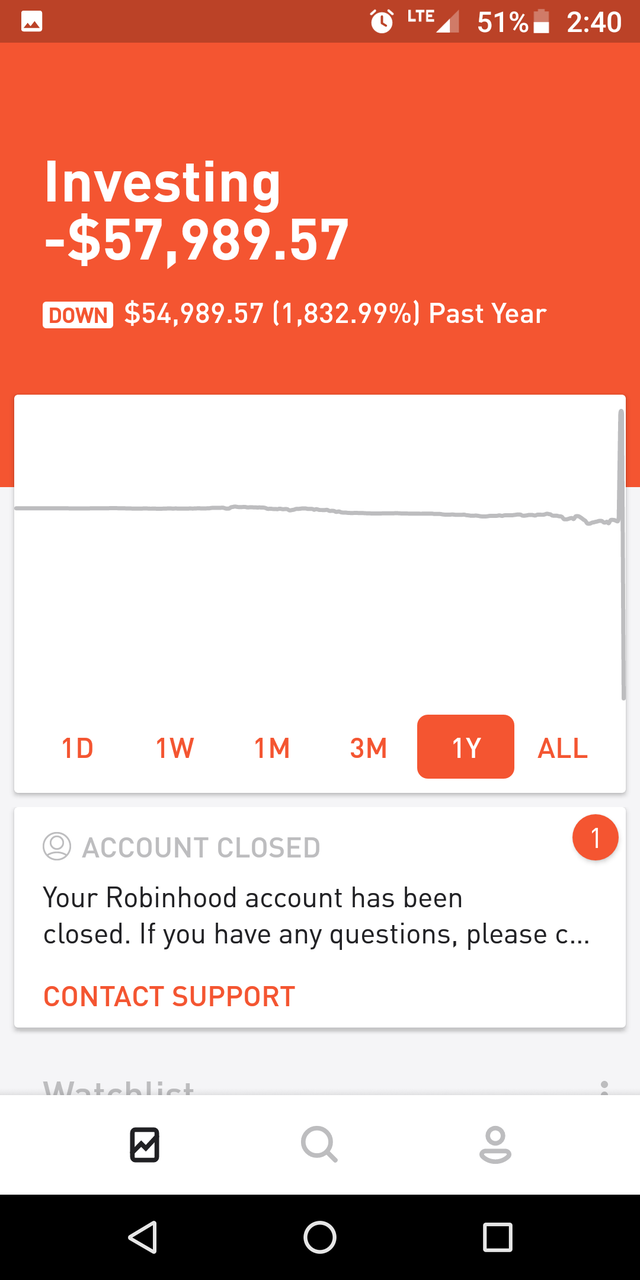
These users subsequently gamble huge amounts of borrowed money away in a coin toss, leaving Robinhood in a very bad spot, perhaps even at odds with Regulation T laws (I am not a lawyer, just speculating here).

“Leverage” is one of the most important concepts to understand in finance, and when used judiciously, is a net positive for everyone involved. It is important for everyone to understand how credit works, and how much leverage is too much. Borrowing more money than you can afford to pay back can take many forms, whether it is taking on college debt, credit card debt, or raising VC money.

Here’s a tutorial on “financial leverage” in the form of a story about lemonade:


Lemonade Leverage


It’s a hot summer, and you decide to start a lemonade stand to make some money. You have 100€, with which you can buy enough ingredients to make 120€ of lemonade for the summer. Your “return on investment”, or ROI, for the summer is 20%, since you ended up with 20% more money than you started with.

You also figure that if you had another 200€, enough people want lemonade that you could sell three times as much lemonade and make 360€. But you don’t have 200€ to spare! What do you do?

You could use the 120€ to build a slightly bigger lemonade operation next year. Assuming you could get a 20% ROI again next summer, you end up with 144€. But it will be many years before you even have 300€! By this time next year, lemonade might be out of fashion and kids might be juuling at home watching Netflix instead. You would much prefer to scale up your lemonade operation now, while you are confident that you can sell lemonade at a "profit margin" of 20%.

Fortunately, your friend “Britney Banker” is very wealthy and can lend you 200€. Britney Banker doesn’t have your entrepreneurial spirit, so she lacks the ability to get a 20% ROI on her own money. She offers to give you 200€ today, in exchange for you giving her 210€ at the end of the year -- an interest rate of 5%. Your “capital leverage ratio” is 100 / 200 = 1:2, because for every dollar you own, Britney is willing to lend you 2€.

If things turn out well, you sell 360€ worth of lemonade, pay Britney back 210€, and pocket the remaining 150€. Starting with 100€, you were able to use borrowed money to “magnify” your return to 50%.

However, if you make 200€ worth of lemonade and fail to sell any of it before the lemonade spoils and became worthless, you would be in a very sticky situation! You would have worthless lemonade and a 210€ debt to Britney. This is far worse than if you had lost your own 100€, because at least you wouldn’t owe anyone anything afterwards. So even though 1:2 leverage may amplify your gains from 20% → 50%, so it may amplify your potential losses from 100% → -310%!

The only reason why Britney is willing to lend you the money in the first place is that Britney thinks this outcome (you losing all of the borrowed money on top of your own assets) is unlikely. If Britney thought that you were less reliable, she might offer you a smaller leverage ratio (e.g. 1 : 1.5).

Lemonade Coupons


Suppose you make a big batch of lemonade (with Britney’s money) and then go door to door selling lemonade, but instead of giving customers a delicious drink right away, you give them a “deep-in-the-lemonade covered call option”. You take their money up front, and give them a coupon that allows them to “buy” a lemonade for free (0€).

The "call option" is referred to as "covered" because you actually have the lemonade to go with the coupon, it's just that you're holding onto the lemonade until the buyer actually redeems the coupon.


You then go back to Britney and say “I have 360€ of lemonade that I’ve made but haven’t sold, and 360€ in cash from selling lemonade options to customers, and as for debts there’s 200€ I’ve borrowed from you. That’s 520€ in net assets, so can I please borrow 1040€?”.

Britney says “sure, that’s a 1:2 leverage ratio”, and writes you a check for 1040€, again with 5% interest. But Britney has made a tragic mistake here! The 360€ in lemonade she counted as your assets are not really yours to spend, because you actually owe them in obligations to customers.

With 1204€ in borrowed assets, you are now leveraged over 1:12 !

You repeat this process again, turning 1040€ cash into 1248€ of lemonade, selling an additional 1248€ of deep-in-the-lemonade options. You now have 1608€ of lemonade, and 1608€ in cash, and 1204€ of debt, for net assets of 1608 + 1608 - 1204 = 2012€.

You go back to Britney and ask to borrow another 4024€, with 5% interest. Again, because Britney is forgetting to account for the 1608€ in lemonade “debt” that you may have to deliver to coupon-holders, she thinks that the leverage is still 1:2. You repeat this process one more time, and your new total position is 6k€ in lemonade, 6k€ in cash, 5k€ net debt.

If you were to successfully deliver 6k€ of lemonade, you would make 1k€ in profit, starting from only 100€ of your own cash. A 1000% return sounds too good to be true, right? That’s because it is.

One hot summer day, all of the coupon holders decide to exercise their coupons at the same time. You realize that your lemonade stand can’t actually fulfill 6k€ in lemonade orders and you are in way over your head. Desperate, you attempt to pivot and come up with a Billy Mcfarland-esque scheme to buy lemonade from a local grocery and dilute it with some water. But due to inexperience with food handling operations, you accidentally contaminate half the batch, and are left with only 3k€ of lemonade. You have 6k€ cash but still owe 3k€ in lemonade and 5k€ in cash.Your 1k€ profit opportunity has now become a 2k€ DEBT (ROI of -2100%), and we haven't even factored in the interest! Because the debtors (lemonade coupon holders and Britney Banker) must be paid regardless of whether you successfully make lemonade or not, your leverage has an asymmetric payoff - the downsides are twice as bad as the upside!

I wish I could say that this story was fictional, but to the best of my understanding this is more or less what /u/ControlTheNarrative and others attempted to do on Robinhood. Substitute "lemonade" for "AMD stock", and "lemonade coupon" for "deep-in-the-money covered call option". Theoretically, Robinhood shouldn't allow you to buy options on margin, but /u/ControlTheNarrative was very clever to use covered call options, which meant that he bought AMD stock with margin (valid) and then created cash and in-the-money AMD call options (sort of like creating matter and antimatter from nothing). Robinhood failed to detect the "antimatter", allowing /u/ControlTheNarrative to mask his "debt", thereby doubling his apparent net assets.

Ok, where did /u/ControlTheNarrative go wrong? It might be possible to still turn a profit by investing the vast amount of leverage in a “safe asset”, right? This seems unlikely: Robinhood’s interest rate of 5% far exceeds the risk-free rate of 1.88% currently offered by a 1-year Treasury note. In other words, it only makes sense to use Robinhood's leverage when you have the ability to deliver annualized returns that exceed 5%. When one has limited assets and a risky investment opportunity, they should instead carefully choose leverage so that they do not end up owing 10x their net worth should they encounter a stroke of bad luck.

Instead of trying to find an investment that minimizes risk while maintaining >5% return, /u/ControlTheNarrative proceeded to then take his enormous leverage and bet all of that on a coin toss: out-of-the-money (OTM) put options against Apple (remember that he is able to buy these options with leveraged cash because it has been "laundered" using covered call options).

Unfortunately for him, Apple proceeded to beat performance expectations for earnings, and subsequently the OTM options became worthless!

Guh!

Acknowledgements


Thanks to Ted Xiao and Daniel Ho for insightful discussion. We had a good laugh. I found the following links helpful in my research:


Friday, December 28, 2018

Uncertainty: a Tutorial

A PDF version of this post can be found here.
Chinese translation by Xiaoyi Yin

Notions of uncertainty are tossed around in conversations around AI safety, risk management, portfolio optimization, scientific measurement, and insurance. Here are a few examples of colloquial use:

  • "We want machine learning models to know what they don't know.''
  • "An AI responsible for diagnosing patients and prescribing treatments should tell us how confident it is about its recommendations.''
  • "Significant figures in scientific calculations represent uncertainty in measurements.''
  • "We want autonomous agents to explore areas where they are uncertain (about rewards or predictions) so that they may discover sparse rewards.''
  • "In portfolio optimization, we want to maximize returns while limiting risk.''
  • "US equity markets finished disappointingly in 2018 due to increased geopolitical uncertainty.''


What exactly then, is uncertainty? 

Uncertainty measures reflect the amount of dispersion of a random variable. In other words, it is a scalar measure of how "random" a random variable is. In finance, it is often referred to as risk.

There is no single formula for uncertainty because there are many different ways to measure dispersion: standard deviation, variance, value-at-risk (VaR), and entropy are all appropriate measures. However, it's important to keep in mind that a single scalar number cannot paint a full picture of "randomness'', as that would require communicating the entire random variable itself! 

Nonetheless, it is helpful to collapse randomness down to a single number for the purposes of optimization and comparison. The important thing to remember is that "more uncertainty'' is usually regarded as "less good'' (except in simulated RL experiments).

Types of Uncertainty


Statistical machine learning concerns itself with the estimation of models $p(\theta|\mathcal{D})$, which in turn estimate unknown random variables $p(y|x)$. Multiple forms of uncertainty come into play here. Some notions of uncertainty describe inherent randomness that we should expect (e.g. outcome of a coin flip) while others describe our lack of confidence about our best guess of the model parameters.

To make things more concrete, let's consider a recurrent neural network (RNN) that predicts the amount of rainfall today from a sequence of daily barometer readings. A barometer measures atmospheric pressure, which often drops when its about to rain. Here's a diagram summarizing the rainfall prediction model along with different kinds of uncertainty.


Uncertainty can be understood from a simple machine learning model that attempts to predict daily rainfall from a sequence of barometer readings. Aleatoric uncertainty is irreducible randomness that arises from the data collection process. Epistemic uncertainty reflects confidence that our model is making the correct predictions. Finally, out-of-distribution errors arise when the model sees an input that differs from its training data (e.g. temperature of the sun, other anomalies).

Aleatoric Uncertainty

Aleatoric Uncertainty draws its name from the Latin root aleatorius, which means the incorporation of chance into the process of creation. It describes randomness arising from the data generating process itself; noise that cannot be eliminated by simply drawing more data. It is the coin flip whose outcome you cannot know.

In our rainfall prediction analogy, aleatoric noise arises from imprecision of the barometer. There are also important variables that the data collection setup does not observe: How much rainfall was there yesterday? Are we measuring barometric pressure in the present day, or the last ice age? These unknowns are inherent to our data collection setup, so collecting more data from that system does not absolve us of this uncertainty.

Aleatoric uncertainty propagates from the inputs to the model predictions. Consider a simple model $y = 5x$, which takes in normally-distributed input $x \sim \mathcal{N}(0,1)$. In this case, $y \sim \mathcal{N}(0, 5)$, so the aleatoric uncertainty of the predictive distribution can be described by $\sigma=5$. Of course, predictive aleatoric uncertainty is more challenging to estimate when the random structure of the input data $x$ is not known.

One might think that because aleatoric uncertainty is irreducible, one cannot do anything about it and so we should just ignore it. No! One thing to watch out for when training models is to choose an output representation capable of representing aleatoric uncertainty correctly. A standard LSTM does not emit probability distributions, so attempting to learn the outcome of a coin flip would just converge to the mean. In contrast, models for language generation emit a sequence of categorical distributions (words or characters), which can capture the inherent ambiguity in sentence completion tasks. 

Epistemic Uncertainty


"Good models are all alike; every bad model is wrong in its own way."

Epistemic Uncertainty is derived from the Greek root epistēmē, which pertains to knowledge about knowledge. It measures our ignorance of the correct prediction arising from our ignorance of the correct model parameters.

Below is a plot of a Gaussian Process Regression model on some toy 1-dimensional dataset. The confidence intervals reflect epistemic uncertainty; the uncertainty is zero for training data (red points), and as we get farther away from training points, the model ought to assign higher standard deviations to the predictive distribution. Unlike aleatoric uncertainty, epistemic uncertainty can be reduced by gathering more data and "ironing out" the regions of inputs where the model lacks knowledge.

1-D Gaussian Process Regression Model showcasing epistemic uncertainty for inputs outside its training set.
There is a rich line of inquiry connecting Deep Learning to Gaussian Processes. The hope is that we can extend the uncertainty-awareness properties of GPs with the representational power of neural networks. Unfortunately, GPs are challenging to scale to the uniform stochastic minibatch setting for large datasets, and they have fallen out of favor among those working on large models and datasets.

If one wants maximum flexibility in choosing their model family, a good alternative to estimating uncertainty is to use ensembles, which is just a fancy way of saying "multiple independently learned models''. While GP models analytically define the predictive distribution, ensembles can be used to compute the empirical distribution of predictions.

Any individual model will make some errors due to randomized biases that occur during the training process. Ensembling is powerful because other models in the ensembles tend to expose the idiosyncratic failures of a single model while agreeing with the correctly inferred predictions.

How do we sample models randomly to construct an ensemble? In Ensembling with bootstrap aggregation, we start with a training dataset of size $N$ and sample $M$ datasets of size $N$ from the original training set (with replacement, so each dataset does not span the entire dataset). The $M$ models are trained on their respective datasets and their resulting predictions collectively form an empirical predictive distribution.

If training multiple models is too expensive, it is also possible to use Dropout training to approximate a model ensemble. However, introducing dropout involves an extra hyperparameter and can compromise single model performance (often unacceptable for real world applications where calibrated uncertainty estimation is secondary to accuracy). 

Therefore, if one has access to plentiful computing resources (as one does at Google), it is often easier to just re-train multiple copies of a model. This also yields the benefits of ensembling without hurting performance. This is the approach taken by the Deep Ensembles paper. The authors of this paper also mention that the random training dynamics induced by differing weight initializations was sufficient to introduce a diverse set of models without having to resort to reducing the training set diversity via bootstrap aggregation. From a practical engineering standpoint, it's smart to bet on risk estimation methods that do not get in the way of the model's performance or whatever other ideas the researcher wants to try.


Out-of-Distribution Uncertainty


For our rainfall predictor, what if instead of feeding in the sequence of barometer readings, we fed in the temperature of the sun? Or a sequence of all zeros? Or barometer readings from a sensor that reports in different units? The RNN will happily compute away and give us a prediction, but the result will likely be meaningless.

The model is totally unqualified to make predictions on data generated via a different procedure than the one used to create the training set. This is a failure mode that is often overlooked in benchmark-driven ML research, because we typically assume that the training, validation, and test sets consist entirely of clean i.i.d data. 

Determining whether inputs are "valid'' is a serious problem for deploying ML in the wild, and is known as the Out of Distribution (OoD) problem. OoD is also synonymous with model misspecification error and anomaly detection.

Besides its obvious importance for hardening ML systems, anomaly detection models are an intrinsically useful technology. For instance, we might want to build a system that monitors a healthy patient's vitals and alerts us when something goes wrong without necessarily having seen that pattern of pathology before. Or we might be managing the "health" of a datacenter and want to know whenever unusual activity occurs (disks filling up, security breaches, hardware failures, etc.)

Since OoD inputs only occur at test-time, we should not presume to know the distribution of anomalies the model encounters. This is what makes OoD detection tricky - we have to harden a model against inputs it never sees during training! This is exactly the standard attack scenario described in Adversarial Machine Learning.

There are two ways to handle OoD inputs for a machine learning model: 1) catch the bad inputs before we even put them through the model 2) let the "weirdness'' of model predictions imply to us that the input was probably malformed.

In the first approach, we assume nothing about the downstream ML task, and simply consider the problem of whether an input is in the training distribution or not. This is exactly what discriminators in Generative Adversarial Networks (GANs) are supposed to do. However, a single discriminator is not completely robust because it is only good for discriminating between the true data distribution and whatever the generator's distribution is; it can give arbitrary predictions for an input that lies in neither distribution. 

Instead of a discriminator, we could build a density model of the in-distribution data, such as a kernel density estimator or fitting a Normalizing Flow to the data. Hyunsun Choi and I investigated this in our recent paper on using modern generative models to do OoD detection.

The second approach to OoD detection involves using the predictive (epistemic) uncertainty of the task model to tell us when inputs are OoD. Ideally, malformed inputs to a model ought to generate "weird'' predictive distribution $p(y|x)$. For instance, Hendrycks and Gimpel showed that the maximum softmax probability (the predicted class) for OoD inputs tends to be lower than that of in-distribution inputs. Here, uncertainty is inversely proportional to the "confidence'' as modeled by the max sofmax probability. Models like Gaussian Processes give us these uncertainty estimates by construction, or we could compute epistemic uncertainty via Deep Ensembles.

In reinforcement learning, OoD inputs are actually assumed to be a good thing, because it represents inputs from the world that the agent does not know how to handle yet. Encouraging the policy to find its own OoD inputs implements "intrinsic curiosity'' to explore regions the model predicts poorly in. This is all well and good, but I do wonder what would happen if such curiousity-driven agents are deployed in real world settings where sensors break easily and other experimental anomalies happen. How does a robot distinguish between "unseen states" (good) and "sensors breaking" (bad)? Might that result in agents that learn to interfere with their sensory mechanisms to generate maximum novelty?

Who Will Watch the Watchdogs?


As mentioned in the previous section, one way to defend ourselves against OoD inputs is to set up  a likelihood model that "watchdogs" the inputs to a model. I prefer this approach because it de-couples the problem of OoD inputs from epistemic and aleatoric uncertainty in the task model. It makes things easy to analyze from an engineering standpoint.

But we should not forget that the likelihood model is also a function approximator, possibly with its own OoD errors! We show in our recent work on Generative Ensembles (and also showed in concurrent work by DeepMind), that under a CIFAR likelihood model, natural images from SVHN can actually be more likely than the in-distribution CIFAR images themselves!

Likelihood estimation involves a function approximator that can itself be susceptible to OoD inputs. A likelihood model of CIFAR assigns higher probabilities to SVHN images than CIFAR test images!

However, all is not lost! It turns out that the epistemic uncertainty of likelihood models is an excellent OoD detector for the likelihood model itself. By bridging epistemic uncertainty estimation with density estimation, we can use ensembles of likelihood models to protect machine learning models against OoD inputs in a model-agnostic way.

Calibration: the Next Big Thing?


A word of warning: just because a model is able to spit out a confidence interval for a prediction doesn't mean that the confidence interval actually reflects the actual probabilities of outcomes in reality! 

Confidence intervals (e.g. $2\sigma$) implicitly assume that your predictive distribution is Gaussian-distributed, but if the distribution you're trying to predict is multi-modal or heavy-tailed, then your model will not be well calibrated!

Suppose our rainfall RNN tells us that there will be $\mathcal{N}(4, 1)$ inches of rain today. If our model is calibrated, then if we were to repeat this experiment over and over again under identical conditions (possibly re-training the model each time), we really would observe empirical rainfall to be distributed exactly $\mathcal{N}(4, 1)$. 

Machine Learning models developed by academia today mostly optimize for test accuracy or some fitness function. Researchers are not performing model selection by deploying the model in repeated identical experiments and measuring calibration error, so unsurprisingly, our models tend to be poorly calibrated.

Going forward, if we are to trust ML systems deployed in the real world (robotics, healthcare, etc.), I think a much more powerful way to "prove our models understand the world correctly'' is to test them for statistical calibration. Good calibration also implies good accuracy, so it would be a strictly higher bar to optimize against. 


Should Uncertainty be Scalar?


As useful as they are, scalar uncertainty measures will never be as informative as the random variables they describe. I find methods like particle filtering and Distributional Reinforcement Learning very cool because they are algorithms that operate on entire distributions, freeing us from resorting to simple normal distributions to keep track of uncertainty. Instead of shaping ML-based decision making with a single scalar of "uncertainty", we can now query the full structure of distributions when deciding what to do. 

The Implicit Quantile Networks paper (Dabney et al.) has a very nice discussion on how to construct "risk-sensitive agents'' from a return distribution. In some environments, one might favor an opportunitistic policy that prefers to explore the unknown, while in other environments unknown things may be unsafe and should be avoided. The choice of risk measure essentially determines how to map the distribution of returns to a scalar quantity that can be optimized against. All risk measures can be computed from the distribution, so predicting full distributions enables us to combine multiple definitions of risk easily. Furthermore, supporting flexible predictive distributions seems like a good way to improve model calibration.


Performance of various risk measures on Atari games as reported by the IQN paper.

Risk measures are a deeply important research topic to financial asset managers. The vanilla Markowitz portfolio objective minimizes a weighted variance of portfolio returns $\frac{1}{2}\lambda w^T \Sigma w$. However, variance is an unintuitive choice of "risk'' in financial contexts: most investors don't mind returns exceeding expectations, but rather wish to minimize the probability of small or negative returns. For this reason, risk measures like Value-at-Risk, Shortfall Probability, and Target Semivariance, which only pay attention to the likelihood of "bad'' outcomes, are more useful objectives to optimize.

Unfortunately, they are also more difficult to work with analytically. My hope is that research into distributional RL, Monte Carlo methods, and flexible generative models will allow us to build differentiable relaxations of risk measures that can play nicely with portfolio optimizers. If you work in finance, I highly recommend reading the IQN paper's "Risks in Reinforcement Learning" section.


Summary


Here's a recap of the main points of this post:
  • Uncertainty/risk measures are scalar measures of "randomness''. Collapsing a random variable to a single number is done for optimization and mathematical convenience.
  • Predictive uncertainty can be decomposed into aleatoric (irreducible noise arising from data collection process), epistemic  (ignorance about true model), and out-of-distribution (at test time, inputs may be malformed).
  • Epistemic uncertainty can be mitigated by softmax prediction thresholding or ensembling.
  • Instead of propagating OoD uncertainty to predictions, we can use a task-agnostic filtering mechanism that safeguards against "malformed inputs''.
  • Density models are a good choice for filtering inputs at test time. However, it's important to recognize that density models are merely approximations of the true density function, and are themselves susceptible to out-of-distribution inputs.
  • Self-plug:Generative Ensembles reduce epistemic uncertainty of likelihood models so they can be used to detect OoD inputs. 
  • Calibration is important and underappreciated in research models.
  • Some algorithms (Distributional RL) extend ML algorithms to models that emit flexible distributions, which provides more information than a single risk measure.

Further Reading

Wednesday, August 8, 2018

Dijkstra's in Disguise

You can find a PDF version of this blog post here.

A weighted graph is a data structure consisting of some vertices and edges, and each edge has an associated cost of traversal. Let's suppose we want to compute the shortest distance from vertex $u$ to every other vertex $v$ in the graph, and we express this cost function as $\mathcal{L}_u(v)$.

For example, if each edge in this graph has cost $1$, $\mathcal{L}_u(v) = 3$.

Dijkstra's, Bellman-Ford, Johnson's, Floyd-Warshall are good algorithms for solving the shortest paths problem. They all share the principle of relaxation, whereby costs are initially overestimated for all vertices and gradually corrected for using a consistent heuristic on edges (the term "relaxation" in the context of graph traversal is not be confused with "relaxation" as used in an optimization context, e.g. integer linear programs). The heuristic can be expressed in plain language as follows:


It turns out that many algorithms I've encountered in my computer graphics, finance, and reinforcement learning studies are all variations of this relaxation principle in disguise. It's quite remarkable (embarrassing?) that so much of my time has been spent on such a humble technique taught in introductory computer science courses!

This blog post is a gentle tutorial on how all these varied CS topics are connected. No prior knowledge of finance, reinforcement learning, or computer graphics is needed. The reader should be familiar with undergraduate probability theory, introductory calculus, and be willing to look at some math equations. I've also sprinkled in some insights and questions that might be interesting to the AI research audience, so hopefully there's something for everybody here.

Bellman-Ford


Here's a quick introduction to Bellman-Ford, which is actually easier to understand than the famous Dijkstra's Algorithm.

Given a graph with $N$ vertices and costs $\mathcal{E}(s, v)$ associated with each directed edge $s \to v$, we want to find the cost of the shortest path from a source vertex $u$ to each other vertex $v$. The algorithm proceeds as follows: The cost to reach $u$ from itself is initialized to $0$, and all the other vertices have distances initialized to infinity. 

The relaxation step (described in the previous section) is performed across all edges in any order for each iteration. The correct distances from $u$ are guaranteed to have propagated completely to all vertices after $N-1$ iterations, since the longest of the shortest paths contain at most $N$ unique vertices. If the relaxation condition indicates there are still yet shorter paths after $N$ iterations, it implies the presence of a cycle whose total cost is negative. You can find a nice animation of the Bellman-Ford algorithm here.

Below is the pseudocode:


Currency Arbitrage


Admittedly, all this graph theory seems sort of abstract and boring at first. But would it still be boring if I told you that efficiently detecting negative cycles in graphs is a multi-billion dollar business? 

The foreign exchange (FX) market, where one currency is traded for another, is the largest market in the world, with about 5 trillion USD being traded every day. This market determines the exchange rate for local currencies when you travel abroad. Let's model a currency exchange's order book (the ledger of pending transactions) as a graph:
  • Each vertex represents a currency (e.g. JPY, USD, BTC).
  • Each directed edge represents the conversion of currency $A$ to currency $B$.

An arbitrage opportunity exists if the product of exchange rates in a cycle exceeds $1$, which means that you can start with 1 unit of currency $A$, trade your way around the graph back to currency $A$, and then end up with more than 1 unit of $A$!

To see how this is related to the Bellman-Ford algorithm, let each currency pair $(A, B)$ with conversion rate $\frac{B}{A}$ be represented as a directed edge from $A$ to $B$ with edge weight $\mathcal{E}(A,B) = \log \frac{A}{B}$. Rearranging the terms,


The above algebra shows that if the sum of edge weights in a cycle is negative, it is equivalent to the product of exchange rates exceeding $1$. The Bellman-Ford algorithm can be directly applied to detect currency arbitrage opportunities! This also applies to all fungible assets in general, but currencies tend to be the most strongly-connected vertices in the graph representing the financial markets.

In my sophomore year of college, I caught the cryptocurrency bug and set out to build an automated arbitrage bot for scraping these opportunities in exchanges. Cryptocurrencies - being unregulated speculative digital assets - are ripe for cross-exchange arbitrage opportunities:

  • Inter-exchange transaction costs are low (assets are ironically centralized into hot and cold wallets).
  • Lots of speculative activity, whose bias generates lots of mispricing.
  • Exchange APIs expose much more order book depth and require no license to trade cryptos. With a spoonful of Python and a little bit of initial capital, you can trade nearly any crypto you want across dozens of exchanges..
Now we have a way to automatically detect mispricings in markets and end up with more money than we started with. Do we have a money printing machine yet? 


Not so fast! A lot of things can still go wrong. Exchange rates fluctuate over time and other people are competing for the same trade, so the chances of executing all legs of the arbitrage are by no means certain. 

Execution of trading strategies is an entire research area on its own, and can be likened to crossing a frozen lake as quickly as possible. Each intermediate currency position, or "leg'', in an arbitrage strategy is like taking a cautious step forward. One must be able to forecast the stability of each step and know what steps proceed after, or else one can get "stuck'' holding a lot of a currency that gives out like thin ice and becomes worthless. Often the profit opportunity is not big enough to justify the risk of crossing that lake.

Simply taking the greedy minimum among all edge costs does not take into account the probability of various outcomes happening in the market. The right way to structure this problem is to think about edge weights being random variables that change over time. In order to compute the expected cost, we need to integrate over all possible path costs that can manifest. Hold this thought, as we will need to introduce some more terminology in the next few sections.

While the arbitrage system I implemented was capable of detecting arb opportunities, I never got around to fully automating the execution and order confirmation subsystems. Unfortunately, I got some coins stolen and lost interest in cryptos shortly after. To execute arb opportunities quickly and cheaply I had to keep small BTC/LTC/DOGE positions in each exchange, but sometimes exchanges would just vanish into thin air. Be careful of what you wish for, or you just might find your money "decentralized'' from your wallet! 

Directional Shortest-Path


Let's introduce another cost function, the directional shortest path $\mathcal{L}_u(v, s \to v)$, that computes the shortest path from $u$ to $v$, where the last traversed edge is from $s \to v$. Just like making a final stop at the bathroom $s$ before boarding an airplane $v$.

Note that the original shortest path cost $\mathcal{L}_u(v)$ is equivalent to the smallest directional shortest path cost among all of $v$'s neighboring vertices, i.e. $\mathcal{L}_u(v) = \min_{s} \mathcal{L}_u(v, s \to v)$ 

Shortest-path algorithms typically associate edges with costs, and the objective is to minimize the total cost. This is also equivalent to trying to maximize the negative cost of the path, which we call $\mathcal{Q}_u = -\mathcal{L}_u(v)$. Additionally, we can re-write this max-reduction as a sum-reduction, where each $\mathcal{Q}_u$ term is multiplied by an indicator function that is $1$ when its $\mathcal{Q}_u$ term is the largest and $0$ otherwise.


Does this remind you of any well-known algorithm? 

If you guessed "Q-Learning", you are absolutely right! 

Q-Learning


Reinforcement learning (RL) problems entail an agent interacting with its environment such that the total expected reward $R$ it receives is maximized over a multi-step (maybe infinite) decision process. In this setup, the agent will be unable to take further actions or receive additional rewards after transitioning to a terminal (absorbing) state.

There are many ways to go about solving RL problems, and we'll discuss just one kind today: value-based algorithms, attempt to recover a value function $Q(s,a)$ that computes the maximum total reward an agent can possibly obtain if it takes an action $a$ at state $s$.

Wow, what a mouthful! Here's a diagram of what's going on along with an annotated mathematical expression.

Re-writing the shortest path relaxation procedure in terms of a directional path cost recovers the Bellman Equality, which underpins the Q-Learning algorithm. It's no coincidence that Richard Bellman of Bellman-Ford is also the same Richard Bellman of the Bellman Equality! Q-learning is a classic example of dynamic programming. 

For those new to Reinforcement Learning, it's easiest to understand Q-Learning in the context of an environment that yields a reward only at the terminal transition:

  • The value of state-action pairs $(s_T, a_T)$ that transition to a terminal state are easy to learn - it is just the sparse reward received as the episode ends, since the agent can't do anything afterwards. 
  • Once we have all those final values, the value for $(s_{T-1}, a_{T-1})$ leading to those states are "backed up'' (backwards through time) to the states that transition to them. 
  • This continues all the way to the state-action pairs $(s_1, a_1)$ encountered at the beginning of episodes. 

Handling Randomness in Shortest-Path Algorithms


Remember the "thin ice'' analogy from currency arbitrage? Let's take a look at how modern RL algorithms are able to handle random path costs. 

In RL, the agent's policy distribution $\pi(a|s)$ is a conditional probability distribution over actions, specifying how the agent behaves randomly in response to observing some state $s$. In practice, policies are made to be random in order to facilitate exploration of environments whose dynamics and set of states are unknown (e.g. imagine the RL agent opens its eyes for the first time and must learn about the world before it can solve a task). Since the agent's sampling of action $a \sim \pi(a|s)$ from the policy distribution are immediately followed by computation of environment dynamics $s^\prime = f(s, a)$, it's equivalent to view randomness as coming from a stochastic policy distribution or stochastic transition dynamics. We redefine a notion of Bellman consistency for expected future returns:

By propagating expected values, Q-learning allows for shortest-path algorithms to essentially be aware of the expected path length, and take transition probabilities of dynamics/policies into account.

Modern Q-Learning


This section discusses some recent breakthroughs in RL research, such as Q-value overestimation, Softmax Temporal Consistency, Maximum Entropy Reinforcement Learning, and Distributional Reinforcement Learning. These cutting-edge concepts are put into the context of shortest-path algorithms as discussed previously. If any of these sound interesting and you're willing to endure a bit more math jargon, read on -- otherwise, feel free to skip to the next section on computer graphics.

Single-step Bellman backups during Q-learning turn out to be rather sensitive to random noise, which can make training unstable. Randomness can come from imperfect optimization over actions during the Bellman Update, poor function approximation in the model, random label noise (e.g. human error in assigning labels to a robotic dataset), stochastic dynamics, or uncertain observations (partial observability). All of these can violate the Bellman Equality, which may cause learning to diverge or get stuck in a poor local minima.

Sources of noise that arise in Q-learning which violate the hard Bellman Equality.
A well-known problem among RL practitioners is that Q-learning suffers from over-estimation; during off-policy training, predicted Q-values climb higher and higher but the agent doesn't get better at solving the task. Why does this happen?

Even if $Q_\theta$ is an unbiased estimator of the true value function, any variance in the estimate is converted into upward bias during the Bellman update. A sketch of the proof: assuming Q values are uniformly or normally distributed about the true value function, the Fisher–Tippett–Gnedenko theorem tells us that applying the max operator over multiple normally-distributed variables is mean-centered around a Gumbel distribution with a positive mean. Therefore the updated Q function, after the Bellman update is performed, will obtain some positively skewed bias! One way to deal with this is double Q-learning, which re-evaluates the optimal next-state action value using an i.i.d $Q$ function. Assuming Q-value noise is independent of the max action, the use of a i.i.d Q function for scoring the best actions makes max-Q estimation unbiased again.

Dampening Q values can also be accomplished crudely by decreasing the discount factor (0.95 is common for environments like Atari), but $\gamma$ is kind of a hack as it is not a physically meaningful quantity in most environments.

Yet another way to decrease overestimation of Q values is to "smooth'' the greediness of the max-operator during the Bellman backup, by taking some kind of weighted average over Q values, rather than a hard max that only considers the best expected value. In discrete action spaces with $K$ possible actions, the weighted average is also known as a "softmax'' with a temperature parameter:

$$\verb|softmax|(x, \tau) = \mathbf{w}^T \mathbf{x}$$

where

$$\mathbf{w}_i = \frac{e^{\mathbf{x}_i/\tau}}{\sum_{j=1}^{K}{e^{\mathbf{x}_j/\tau}}}$$

Intuitively, the "softmax'' can be thought of as a confidence penalty on how likely we believe $\max Q(s^\prime, a^\prime)$ to be the actual expected return at the next time step.  Larger temperatures in the softmax drag the mean away from the max value, resulting in more pessimistic (lower) Q values. Because of this temeprature-controlled softmax, our reward objective is no longer simply to "maximize expected total reward''; rather, it is more similar to "maximizing the top-k expected rewards''. In the infinite-temperature limit, all Q-values are averaged equally and the softmax becomes a mean, corresponding to the return of a completely random policy. Hold that thought, as this detail will be visited again when we discuss computer graphics!

This modification to the standard Hard-Max Bellman Equality is known as Softmax Temporal Consistency. In continuous action spaces, the backup through an entire episode can be thought of as repeatedly backing up expectations over integrals.


By introducing a confidence penalty as an implicit regularization term, our optimization objective is no longer optimizing for the cumulative expected reward from the environment. In fact, if the policy distribution has the form of a Boltzmann Distribution:

$$\pi(a|s) \sim \exp Q(s, a)$$

This softmax regularization has a very explicit, information-theoretic interpretation: it is the optimal solution for the Maximum-Entropy RL objective:


$$\pi_{\mathrm{MaxEnt}}^* = \arg\!\max_{\pi} \mathbb{E}_{\pi}\left[ \sum_{t=0}^T r_t + \mathcal{H}(\pi(\cdot | \mathbf{s}_t)) \right]$$

An excellent explanation for the maximum entropy principle is reproduced below from Brian Ziebart's PhD thesis:

When given only partial information about a probability distribution, $\tilde{P}$, typically many different distributions, $P$, are capable of matching that information. For example, many distributions have the same mean value. The principle of maximum entropy resolves the ambiguity of an under-constrained distribution by selecting the single distribution that has the least commitment to any particular outcome while matching the observational constraints imposed on the distribution.

This is nothing more than "Occam's Razor'' in the parlance of statistics. The Maximum Entropy Principle is a framework for limiting overfitting in RL models, as it limits the amount of information (in nats) contained by the policy. The more entropy a distribution has, the less information it contains, and therefore the less "assumptions'' about the world it makes. The combination of Softmax Temporal Consistency with Boltzmann Policies is known as Soft Q-Learning.

To draw a connection back to currency arbitrage and the world of finance, limiting the number of assumptions in a model is of paramount importance to quantiatiative researchers at hedge funds, since hundreds of millions of USD could be at stake. Quants have developed a rather explicit form of Occam's Razor by tending to rely on models with as few statistical priors as possible, such as Linear models and Gaussian Process Regression with simple kernels.

Although Soft Q-Learning can regularize against model complexity, updates are still backed up over single timesteps. It is often more effective to integrate rewards with respect to a "path'' of samples actually sampled at data collection time, than backing up expected Q values one edge at a time and hoping that softmax temporal consistency remains consistent well when accumulating multiple backups. 

Work from Nachum et al. 2017, O’Donoghue et al. 2016, Schulman et al. 2017 explore the theoretical connections between multi-step return optimization objectives (policy-based) and temporal consistency (value-based) objectives. The use of a multi-step return can be thought of as a path-integral solution to marginalizing out random variables occuring during a multi-step decision process (such as random non-Markovian dynamics). In fact, long before Deep RL research became popular, control theorists have been using path integrals for optimal control to tackle the problem of integrating multi-step stochastic dynamics [1, 2]. A classic example is the use of the Viterbi Algorithm in stochastic planning.

Once trained, the value function $Q(s,a)$ implies a sequence of actions an agent must do in order to maximize expected reward (this sequence does not have to be unique). In order for the $Q$ function to be correct, it must also implicitly capture knowledge about the expected dynamics that occur along the sequence of actions. It's quite remarkable that all this "knowledge of the world and one's own behavior'' can be captured into a single scalar.

However, this representational compactness can also be a curse!

Soft Q-learning and PGQ/PCL successfully back up expected values over some return distribution, but it's still a lot to ask of a neural network to capture all the knowledge about expected future dynamics, marginalize all the randomness into a single statistic. 

We may be interested in propagating other statistics like variance, skew, and kurtosis of the value distribution. What if we did Bellman backups over entire distributions, without having to throw away the higher-order moments? 

This actually recovers the motivation of Distributional Reinforcement Learning, in which "edges'' in the shortest path algorithm propagate distributions over values rather than collapsing everything into a scalar. The main contribution of the seminal Bellemare et al. 2017 paper is defining an algebra that generalizes the Bellman Equality to operate on distributions rather than scalar statistics of them. Unlike the path-integral approach to Q-value estimation, this framework avoids marginalization error by passing richer messages in the single-step Bellman backups. 

Soft-Q learning, PGQ/PCL, and Distributional Reinforcement Learning are "probabilistically aware'' reinforcement learning algorithms. They appear to be tremendously beneficial in practice, and I would not be surprised if by next year it becomes widely accepted that these techniques are the "physically correct'' thing to do, and hard-max Q-learning (as done in standard RL evaluations) is discarded. Given that multi-step Soft-Q learning (PCL) and Distributional RL take complementary approaches to propagating value distributions, I'm also excited to see whether the approaches can be combined (e.g. policy gradients over distributional messages).

Physically-Based Rendering


Ray tracing is not slow, computers are. -- James Kajiya

A couple of the aforementioned RL works make heavy use of the terminology "path integrals''. Do you know where else path integrals and the need for "physical correctness'' arise? Computer graphics!

Whether it is done by an illustrator's hand or a computer, the problem of rendering asks "Given a scene and some light sources, what is the image that arrives at a camera lens?''. Every rendering procedure -- from the first abstract cave painting to Disney's modern Hyperion renderer, is a depiction of light transported from the world to the eye of the observer.


Here are some examples of the enormous strides rendering technology has made in the last 20 years:

From top left, clockwise: Big City Overstimulation by Gleb Alexandrov. Pacific Rim, Uprising. The late Peter Cushing resurrected for a Star Wars movie. Remove Henry's Cavill's mustache to re-shoot some scenes because he needs the mustache for another movie.

Photorealistic rendering algorithms are made possible thanks to accurate physical models of how light behaves and interacts with the natural world, combined with the computational resources to actually represent the natural world in a computer. For instance, a seemingly simple object like a butterfly wing has an insane amount of geometric detail, and light interacts with this geometry to produce some macroscopic effect like iridescence.


Light transport involves far too many calculations for a human to do by hand, so the old master painters and illustrators came up with a lot of rules about how light behaves and interacts with everyday scenes and objects. Here are some examples of these rules:

  • Cold light has a warm shadow, warm light has a cool shadow.
  • Light travels through tree leaves, resulting in umbras that are less "hard" than a platonic sphere or a rock.
  • Clear water and bright daylight result in caustics.
  • Light bounces off flat water like a billiard ball with a perfectly reflected incident angle, but choppy water turns white and no longer behaves like a mirror.

You can get quite far on a big bag of heuristics like these. Here are some majestic paintings from the Hudson River School (19th century).

Albert Bierstadt, Scenery in the Grand Tetons, 1865-1870
Albert Bierstadt, Among the Sierra Nevada Mountains, California, 1868
Mortimer Smith: Winter Landscape, 1878
However, a lot of this painterly understanding -- though breathtaking -- was non-rigorous and physically inaccurate. Scaling this up to animated sequences was also very laborious. It wasn't until 1986, with the independent discovery of the rendering equation by David Immel et al. and James Kajiya, that we obtained physically-based rendering algorithms.

Of course, the scene must obey the conservation of energy transport: the electromagnetic energy being fed into the scene (via radiating objects) must equal the total amount of electromagnetic energy being absorbed, reflected, or refracted in the scene. Here is the rendering equation explained in an annotated equation:


A Monte Carlo estimator is a method for estimating high-dimensional integrals, by simply taking the expectation over many independent samples of an unbiased estimator. Path-tracing is the simplest Monte-Carlo approximation possible to the rendering equation. I've borrowed some screenshots from Disney's very excellent tutorial on production path tracing to explain how "physically-based rendering'' works. 

Initially, the only thing visible to the camera is the light source. Let there be light!
A stream of photons is emitted from the light and strikes a surface (in this case, a rock). It can be absorbed into non-visible energy, reflected off the object, or refracted into the object.
Any reflected or refracted light is emitted from the surface and continues in another random direction, and the process repeats until there are no photons left or it is absorbed by the camera lens.
This process is repeated ad infinum for many rays until the inflow vs. outflow of photons reaches equilibrium or the artist decides that the computer has been rendering for long enough. The total light contribution to a surface is a path integral over all these light bounce paths.
This equation has applications beyond entertainment: the inverse problem is studied in astrophysics simulations (given observed radiance of a supernovae, what are the properties of its nuclear reactions?), and the neutron transport problem. In fact, Monte Carlo methods for solving integral equations were developed for studying fissile reactions for the Manhattan Project! The rendering integral is also an Inhomogeneous Fredholm equations of the second kind, which have the general form:

$${\displaystyle \varphi (t)=f(t)+\lambda \int _{a}^{b}K(t,s)\varphi (s)\,\mathrm {d} s.}$$

Take another look at the rendering equation. Déjà vu, anyone?

Once again, path tracing is nothing more than the Bellman-Ford heuristic encountered in shortest-path algorithms! The rendering integral is taken over the $4\pi$ steradian's of surface area on a unit sphere, which cover all directions an incoming light ray can come from. If we interpret this area integration probabilistically, this is nothing more than the expectation (mean) over directions sampled uniformly from a sphere.

This equation takes the same form as the high-temperature softmax limit for Soft Q-learning! Recall that as $\tau \to \infty$, softmax converges to an expectation over a uniform distribution, i.e. a policy distribution with maximum entropy and no information. Light rays have no agency, they merely bounce around the scene like RL agents taking completely random actions! 

The astute reader may wonder whether there is also a corresponding "hard-max'' version of rendering, just as hard-max Bellman Equality is to the Soft Bellman Equality in Q-learning. 

The answer is yes! The recursive raytracing algorithm (invented before path-tracing, actually) was a non-physical approximation of light transport that assumes the largest of lighting contributions reflected off a surface comes from one of the following light sources:

  1. Emitting material
  2. Direct exposure to light sources
  3. Strongly reflected light (i.e. surface is a mirror)
  4. Strongly refracted light (i.e. surface is made of glass or water).

In the case of reflected and refracted light, recursive trace rays are branched out to perform further ray intersection, usually terminating at some fixed depth.


Raytracing approximation to the rendering equation.

Because ray tracing only considers the maximum contribution directions, it is not able to model indirect light, such as light bouncing off a bright wall and bleeding into an adjacent wall. Although these contributions are minor in today setups like Cornell Boxes, they play a dominant role in rendering pictures of snow, flesh, and food. 

Below is a comparison of a ray-traced image and a path-traced image. The difference is like night and day:


Prior work has drawn connections between light transport and value-based reinforcement learning, and in fact Dahm and Keller 2017 leverage Q-learning to learn optimal selection of "ray bounce actions'' to accelerate importance sampling in path tracing. Much of the physically-based rendering literature considers the problem of optimal importance sampling to minimize variance of the path integral estimators, resulting in less "noisy'' images. 

For more information on physically-based rendering, I highly recommend Benedikt Bitterli's interactive tutorial on 2D light transport, Pat Hanrahan's book chapter on Monte Carlo Path Tracing, and the authoritative PBR textbook.

Summary and Questions


We have 3 very well-known algorithms (currency arbitrage, Q-learning, path tracing) that independently discovered the principle of relaxation used in shortest-path algorithms such as Dijkstra's and Bellman-Ford. Remarkably, each of these disparate fields of study discovered notions of hard and soft optimality, which is relevant in the presence of noise or high-dimensional path integrals. Here is a table summarizing the equations we explored:


These different fields have quite a lot of ideas that could be cross-fertilized. Just to toss some ideas out there (a request for research, if you will):

  • There has been some preliminary work on using optimal control to reduce sample complexity of path tracing algorithms. Can sampling algorithms used in rendering be leveraged for reinforcement learning?
  • Path tracing integrals are fairly expensive because states and actions are continuous and each bounce requires ray-intersecting a geometric data structure. What if we do light transport simulations on a point cloud with a precomputed visibility matrix between all points, and use that as an approximation for irradiance caching / final-gather?
  • Path tracing is to Soft Q-Learning as Photon Mapping is to ...?
  • Has anyone ever tried using the Maximum Entropy principle as a regularization framework for financial trading strategies?
  • The selection of a proposal distribution for importance-sampled Monte Carlo rendering could utilize Boltzmann Distributions with soft Q-learning. This is nice because the proposal distribution over recursive ray directions has infinite support by construction, and Soft Q-learning can be used to tune random exploration of light rays.
  •  Is there a distributional RL interpretation of path tracing, such as polarized path tracing?
  • Given the equivalence between Q Learning and shortest path algorithms, it's interesting to note that in Deep RL research, we carefully initialize weights but leave the Q-function values fairly arbitrary. However, all shortest-path algorithms rely on initializing costs to negative infinity, so that costs being propagated during relaxation correspond to actually realizable paths. Why aren't we initializing all function values to negative-valued numbers?

Acknowledgements


I'm very grateful to Austin Chen, Deniz Oktay, Ofir Nachum, and Vincent Vanhoucke for proofreading and providing feedback to this post. All typos/factual errors are my own; please write to me if you spot additional errors. And finally, thank you for reading!